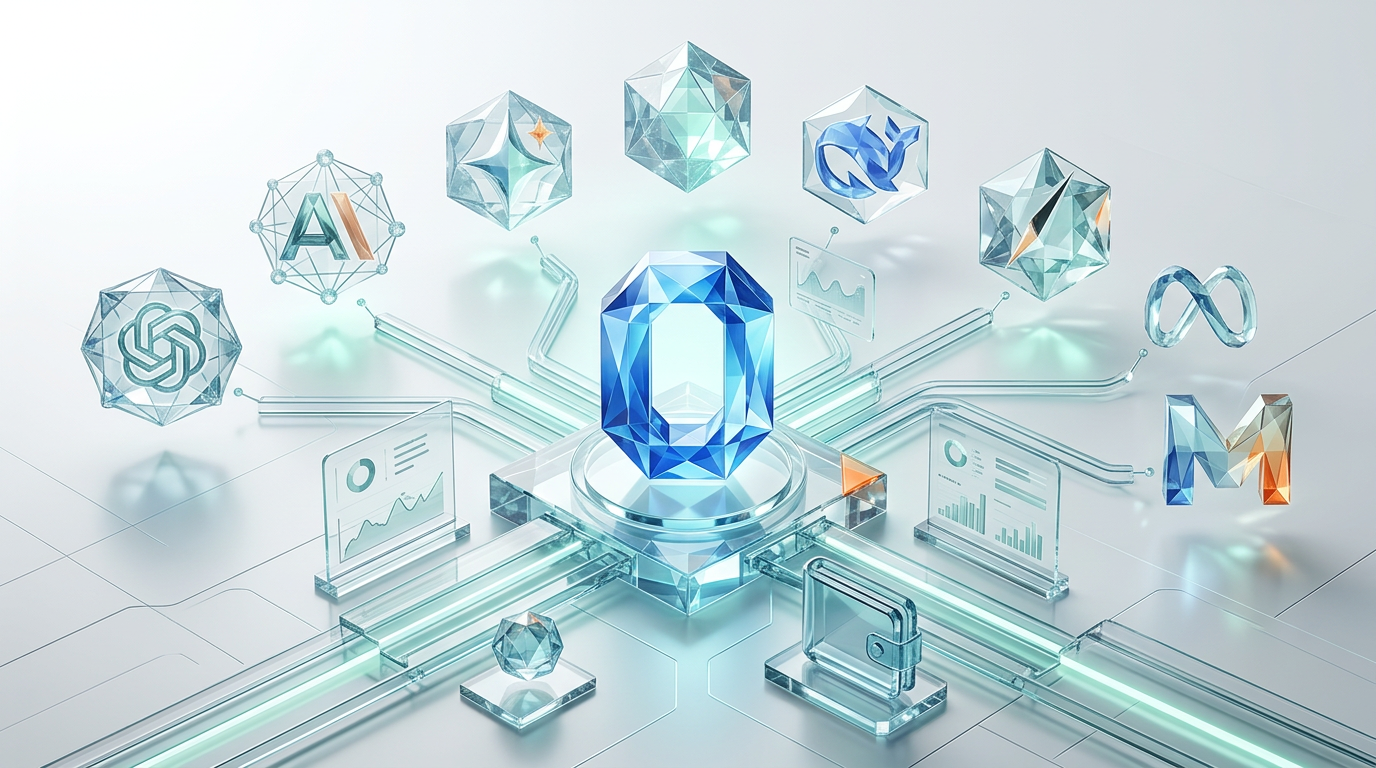
Teams search for an AI API gateway when one provider is no longer enough. The first integration may start with OpenAI. Then the product needs Claude for long reasoning, Gemini for multimodal tasks, DeepSeek for efficient reasoning, Grok for experiments, Llama or Mistral for cost control, embeddings for search, and media models for images, video, or audio.
Without a gateway, every provider becomes a separate project. Developers maintain different payloads, keys, retry rules, rate limits, invoices, dashboards, and failure modes. That works for a prototype, but it becomes fragile once customers depend on the product.
An AI API gateway solves this by making the application call one stable surface. Behind that surface, the platform decides which provider route should handle the request. Admins can configure model access, provider accounts, wallet rules, and failover behavior without asking developers to rewrite the product every time the model strategy changes.
The strongest gateway pattern has four layers. The first layer is developer compatibility: one API shape that feels predictable. The second layer is model routing: send each job to the route that fits cost, quality, and latency. The third layer is billing: capture request cost, wallet holds, usage history, and user-level limits. The fourth layer is reliability: keep fallback routes ready when a key, account, quota, or provider route fails.
Omixa is built around that full operating model. It is not only a list of model endpoints. It connects model access with API keys, wallet billing, usage logs, route health, provider accounts, and admin controls. This lets a team move faster while keeping the business side of AI visible.
For product teams, the gateway also protects future choices. The best model for a workflow may change next month. Pricing may change. A provider may become unavailable in a region. A new model family may outperform the current default. If the app is hard-coded to every vendor, each change becomes engineering work. If the app calls one gateway, the team can update the route instead.
This is why searches such as "AI API gateway", "all AI models in one API", "OpenAI Claude Gemini API", "DeepSeek API gateway", and "Claude API gateway" are high-intent. The searcher is usually not browsing casually. They already have a product, a deadline, a cost problem, or a reliability risk.
The professional answer is one integration with many controlled routes. Use OpenAI where it fits. Use Claude where long reasoning or writing quality matters. Use Gemini for multimodal workflows where it performs well. Use DeepSeek, Llama, Mistral, or other families where cost and task fit are better. Keep the user experience stable through Omixa while the model layer keeps improving behind the scenes.
AI API gateway for OpenAI, Claude, Gemini, and DeepSeek
A practical playbook for teams searching for one AI API gateway that can route OpenAI, Claude, Gemini, DeepSeek, Grok, Llama, Mistral, and media models.